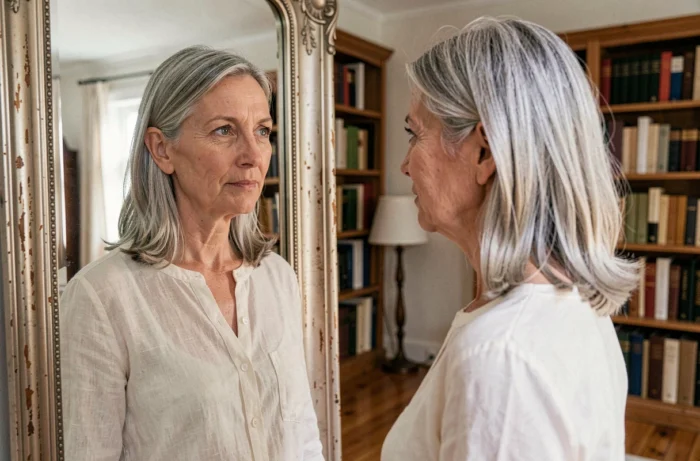
Beauty refers to the quality attributed to an object, a living being or an experience that evokes perceptual or intellectual pleasure. This definition, formulated in antiquity by the discipline of philosophical aesthetics, remains relevant today. Exploring beauty and its meaning means asking which aspects of our perception are matters of personal judgment and which seem to be shared by everyone.
Subjective beauty and universal beauty: two distinct categories
When Plato speaks of beauty, he places it beyond the sensory world. For him, beauty is an ideal, absolute form that concrete objects can only imperfectly imitate. This view assumes a universal beauty, identical for all minds capable of apprehending it.
Kant proposes a different mechanism. In his view, aesthetic judgment is based neither on concepts nor on utility. Someone who finds a landscape beautiful is not describing a property of that landscape, but expressing a feeling they assume others can share. Kantian beauty is neither objective nor purely private: it lies in that in-between space where the subject claims to speak for others without being able to prove it.
The distinction between these two categories still shapes contemporary debates in the philosophy of art. To say that a piece of music is beautiful is to make a statement that wavers between personal taste and the conviction that one is expressing something valid beyond oneself. A deeper exploration of beauty and its meaning helps clarify this tension between subjectivity and the claim to universality.

Physical appearance and social norms: when beauty becomes a standard
When applied to bodies, the concept of beauty shifts into a different register. It moves away from disinterested contemplation and enters a system of social, economic and media-driven norms. Standards of physical beauty vary from one society and era to another, confirming that they are socially constructed.
The role of social comparison online
A systematic review and meta-analysis published in 2025 (Bonfanti et al., Body Image) found an association between online social comparison and body image concerns. The authors note that the studies remain heterogeneous and are often observational: a direct causal link between social media and body dissatisfaction has not been definitively established.
More specifically, another 2025 meta-analysis (Ooi et al., Body Image) reports that the relationship between appearance comparison and body dissatisfaction works both ways among women. Comparing oneself to others is associated with dissatisfaction, but dissatisfaction also leads to more frequent comparison. This cycle makes any simplistic interpretation of the phenomenon difficult.
The type of content matters more than screen time
Time spent on social media is not the most telling factor. What produces measurable short-term effects on body satisfaction is the type of imagery people consume. A 2025 experimental meta-analysis involving young women shows that not all images online have the same effects. Idealized content (retouched bodies, carefully staged poses) triggers different reactions from neutral or diverse content.
This finding shifts the focus. The question is not whether the beauty presented online is “real” or “fake,” but which psychological mechanisms it activates.
Beauty in art and nature: pleasure without purpose
Returning to beauty beyond the realm of the body allows us to rediscover what Kant called “disinterested pleasure.” A painting, a piece of music or a natural landscape can bring a kind of satisfaction that depends neither on its usefulness nor on its conformity to a standard.
- Natural beauty (a sky, a geological formation, a tree) was not created to please, which sets it radically apart from beauty shaped by society or advertising.
- Artistic beauty involves intention and a creative act, but the pleasure it brings cannot be reduced to understanding that intention.
- Mathematical beauty (an elegant proof, a symmetry) belongs to an intellectual register in which pleasure arises from clarity and economy of means.
These three forms of beauty have one thing in common: they escape the logic of standards and comparison. No one feels diminished by a sunset.

The philosophy of everyday beauty: how beauty changes our lives
Beauty is not confined to museums or philosophical treatises. It plays a part in everyday decisions: choosing an outfit, arranging a home, taking one route rather than another on the way back. These small aesthetic choices shape our relationship with the world, even when we do not put them into words.
Recognizing beauty in everyday life requires us to slow down and pay attention. In the strict sense, aesthetics is first and foremost a matter of perception. Seeing beauty in an ordinary object calls for the same kind of attention Kant described in relation to art: a gaze that temporarily suspends judgments of utility.
This ability is neither innate nor fixed. It can be cultivated through repeated exposure to a variety of forms, through engaging with art and nature, or simply by getting into the habit of noticing what in our surroundings brings pleasure without serving a practical purpose.
Beauty, whether it concerns a face, a symphony or the light of morning, always involves the same fundamental act: valuing what serves no purpose. It is precisely this quality of being freely given that makes beauty so difficult to define and impossible to exhaust.