
Paris Metro Line 6 runs from Charles de Gaulle-Étoile to Nation, following an arc through the south of Paris. Its 28 stations connect with several metro lines, two RER lines and bus networks. This wealth of connections makes it a key route for hundreds of thousands of daily passengers, but not all transfers are equally convenient: some are direct, while others involve a walk or a change of building.
RER connections on Line 6: two stations, two different experiences
Only two Line 6 stations have a listed connection to the RER network. The first, Charles de Gaulle-Étoile, connects with RER A. The transfer is within the same underground complex, so there is no need to go above ground.
The second, Denfert-Rochereau, connects Line 6 with RER B. This transfer is shared with Metro Line 4, creating heavy passenger flows during rush hour. The passageways between the metro and the RER platform can add several minutes to your transfer, depending on how busy they are.
One special case is worth noting: Bir-Hakeim is often associated with RER C via Champ-de-Mars-Tour-Eiffel station. However, this is not a direct connection. The journey between the two involves walking above ground, which can be a real challenge for passengers with reduced mobility or heavy luggage. For station-by-station details, consult the metro guide on Nws Online to check distances before planning your route.
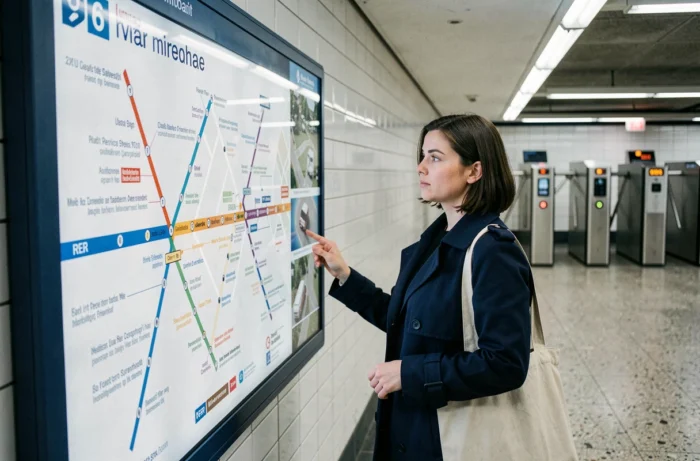
Metro connections: stations to know between Étoile and Nation
Line 6 connects with most of the other lines on the metro network. The usefulness of each connection depends on your direction of travel. The table below lists the main interchange stations and the lines available, based on data published by Île-de-France Mobilités.
| Station | Connecting metro lines |
|---|---|
| Charles de Gaulle-Étoile | Line 1, Line 2 |
| Trocadéro | Line 9 |
| La Motte-Picquet-Grenelle | Line 8, Line 10 |
| Pasteur | Line 12 |
| Montparnasse-Bienvenüe | Line 4, Line 12, Line 13 |
| Raspail | Line 4 |
| Denfert-Rochereau | Line 4 |
| Place d’Italie | Line 5, Line 7 |
| Bercy | Line 14 |
| Nation | Line 1, Line 2, Line 9 |
Montparnasse-Bienvenüe has the most connections on Line 6, with three metro lines and access to the Transilien network (Line N). It is also the station with the longest transfer corridors, particularly for Line 13.
At Nation, the eastern terminus of the line, connections with Lines 1, 2 and 9 make it a major interchange for travel to eastern and northeastern Paris. At the other end, Charles de Gaulle-Étoile serves the same role for the west and RER A.
Stations without connections
Around ten Line 6 stations have no listed metro connections: Kléber, Boissière, Passy, Bir-Hakeim, Dupleix, Cambronne, Sèvres-Lecourbe, Edgar Quinet, Corvisart and Saint-Jacques. These stations serve residential or tourist areas, but passengers who need to change lines should plan to travel to the nearest interchange station.
Bus and Transilien connections: often overlooked
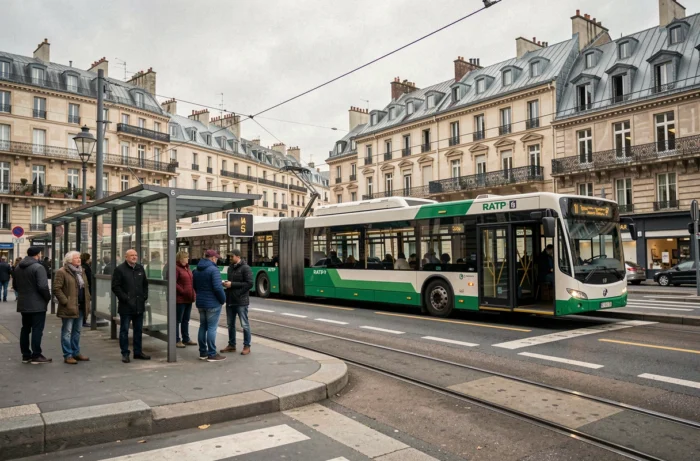
Connections to bus routes are not always shown on simplified metro maps. Yet Line 6 intersects with dozens of RATP bus routes along its route. Bus stops are generally close to station exits, but the actual distance varies.
Three points are worth checking before you travel:
- Bus routes serving Montparnasse-Bienvenüe cover a wide area (Montparnasse station, Boulevard du Montparnasse and Rue de Rennes), so your bus stop may be several hundred metres from the nearest metro exit.
- At Denfert-Rochereau, buses heading to the southern suburbs depart from stops around the square, rather than from a single centralised terminus.
- Bercy station provides access to the Transilien network via Paris-Bercy-Bourgogne-Pays d’Auvergne station, which is useful for journeys to central France. This connection involves exiting the station and walking for a few minutes.
As for trams, no Line 6 station offers a direct connection to the tram network. Lines T3a and T3b run farther south, along the Boulevards des Maréchaux. From Line 6, Place d’Italie and Denfert-Rochereau offer the shortest onward journeys, either by changing metro lines or walking.
Closures and works: when connections are no longer available
Line 6, which includes several elevated sections (the Passy and Austerlitz viaducts), is regularly affected by maintenance work. These disruptions do more than interrupt direct travel between two stations.
A station closure also cuts off access to the connections it serves. When a station such as Montparnasse-Bienvenüe or Denfert-Rochereau is closed on Line 6, its metro and RER connections remain accessible via the other lines serving it, but not from Line 6 itself. Replacement buses generally cover only part of the line and do not replicate all its connections.
Before any journey involving a transfer on Line 6, checking live service updates is the most reliable precaution. Information published by RATP and Île-de-France Mobilités lists planned closures, but last-minute disruptions are only shown on their traffic information channels.
Line 2, which follows a similar arc through the north of Paris, can serve as an alternative if the entire line is closed. The two lines share their termini (Étoile and Nation), making it possible to bypass the south by travelling through the north. Journey times are comparable, but the intermediate stations served are completely different.