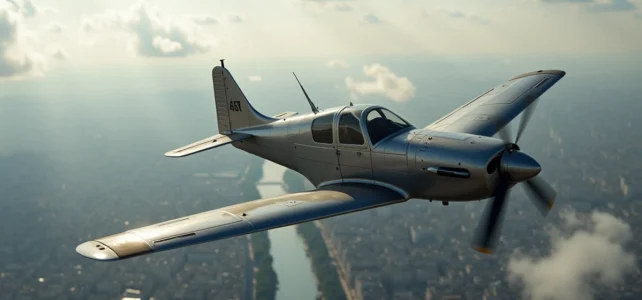
Flying over Paris in a light aircraft is not just a contemplative stroll. The French regulatory framework imposes specific constraints that determine what the passenger will actually see from the cockpit, and especially what they will not see. Understanding these rules before booking a discovery flight avoids disappointments and allows for the selection of the right itinerary.
Overflight restrictions in the urban area of Paris: what the regulations allow
The area of Paris within the city limits is classified as controlled airspace, with minimum altitudes for overflights strictly regulated by the Air Transport Code. Any flight over an urban area must adhere to a minimum altitude that ensures, in the event of an engine failure, an emergency landing without endangering people on the ground.
You may also like : Distance Learning: Discover the Best Solutions for Training from Home
In practice, a light aircraft cannot descend to low altitude over the Eiffel Tower or Notre-Dame. The flight paths circumvent the dense center of Paris and instead follow the river axes or less constrained suburban areas. The pilot adjusts their route according to the clearances issued by the Paris region air traffic control, meaning that two identical flights on paper can offer very different views depending on the day’s traffic.
This operational reality explains why the majority of discovery flights favor a route in Île-de-France rather than a direct overflight of the capital. The castles, valleys, and large parks provide more regulation-friendly viewpoints, and often more spectacular than a high-altitude overflight of the urban fabric.
See also : Discover the overview of the site www.missmarion.fr and explore its various sections
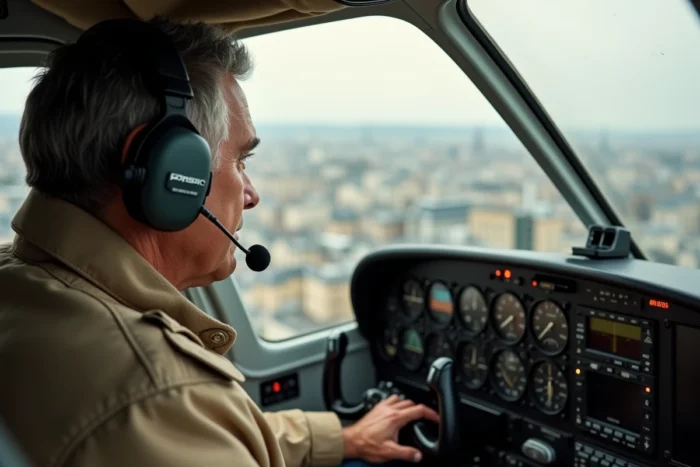
Departure airfields and types of aircraft for a discovery flight in Île-de-France
Tourist flights around Paris take off from airfields dedicated to light aviation, distinct from commercial platforms like Orly or Roissy-CDG. The Lognes airfield, in Seine-et-Marne, concentrates part of the offering with structures like the 3FLY flying club, which offers introductory flights in a Piper PA-28, a low-wing single-engine aircraft commonly used for this type of service.
We recommend checking the type of aircraft before making any reservation. A Piper PA-28 offers good lateral visibility due to its low wings, while a Cessna 172 (high-wing) allows for better observation of the ground during turns. The choice of aircraft directly influences the quality of the photographic experience. Details of the packages offered from several airfields in the Île-de-France region can be found on the website www of Paris seen from the sky, which centralizes the available options.
- Lognes (LFPL): quick access from eastern Paris, routes oriented towards Disneyland Paris and Vaux-le-Vicomte
- Saint-Cyr-l’École (LFPZ): immediate proximity to Versailles, possible overflight of the castle and the Grand Canal
- Pontoise-Cormeilles (LFPT): to the northwest, routes towards the Oise valley and the loops of the Seine
The departure airfield determines the itinerary as much as the passenger’s wishes. A flight from Lognes will not offer the same perspectives as a departure from Saint-Cyr, even with an equivalent duration.
Flight duration and itineraries: what an introductory flight really allows you to see
A standard introductory flight lasts about thirty minutes of actual flight time. This time slot is sufficient to cover a coherent geographical arc, but not to circle the entire Île-de-France. Thirty minutes in a Piper PA-28 covers a usable radius of about forty kilometers around the departure airfield, taking into account the climb and descent phases.
The pre-established routes generally target two or three major points of interest. From Lognes, the classic route passes through the Marne valley and then Disneyland Paris, recognizable by its geometry from the sky. From Saint-Cyr, the Palace of Versailles is the focal point, with a passage over the French gardens whose patterns take on a spectacular dimension when viewed from above.
We observe that passenger satisfaction depends less on duration than on the clarity of ground references. A flight in clear weather with three identifiable monuments leaves a stronger impression than an hour of flying under a fragmented cloud layer. The weather remains the determining factor for the quality of the overflight, far more than budget or duration.
Weather conditions and preferred time slots
Flying in a light aircraft depends on visual flight rules (VFR), which impose minimum visibility and sufficient cloud ceiling. In Île-de-France, summer mornings statistically offer the best conditions: stable air, favorable low light for photography, and less dense air traffic at small airfields.
Time slots in the late afternoon have appeal for golden light, but thermal turbulence increases in summer after mid-afternoon. For a first flight, the morning slot remains the most comfortable, especially for those sensitive to the aircraft’s movements.
Prices and flight formats: introductory flight, initiation flight, or personalized flight
The offering is segmented into three distinct categories that do not meet the same need.
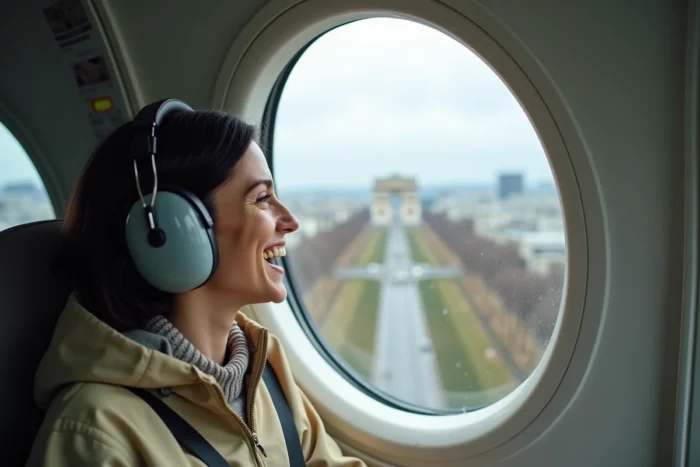
- Introductory flight: the passenger observes from the right seat while the pilot manages the entire flight. This format is suitable for those seeking a contemplative experience without technical involvement
- Initiation flight: the passenger takes the controls under the supervision of the instructor pilot for part of the flight. This format is aimed at aviation enthusiasts who want to understand piloting
- Personalized flight: itinerary defined in advance with the pilot to overfly a specific location (family property, castle, historical site). This format requires prior coordination with air traffic control
The choice between these options directly influences the price, but also the route. An initiation flight dedicates time to learning maneuvers, which mechanically reduces the portion dedicated to observing the landscape.
What the price includes and excludes
The displayed price covers the time of engine running flight, passenger insurance, and the pre-flight briefing. Landing fees at a different airfield from the departure, any airfield taxes, and cancellation insurance are not always included. Checking these items avoids surprises at the time of payment.
One last technical point often overlooked: the weight of passengers influences the aircraft’s balance and can limit the amount of fuel carried, thus affecting the effective flight duration. Some operators ask for the weight of each occupant at the time of booking to calculate the mass and balance estimate, which is not intrusive but is a matter of aviation safety.
Flying over Paris and Île-de-France in a light aircraft remains a niche experience, far removed from mass tourism. The regulatory constraint, far from being a hindrance, structures itineraries that reveal landscapes overlooked by traditional tours. The Palace of Versailles seen at five hundred meters altitude or the meanders of the Marne in the early morning justify the detour to a Île-de-France airfield.