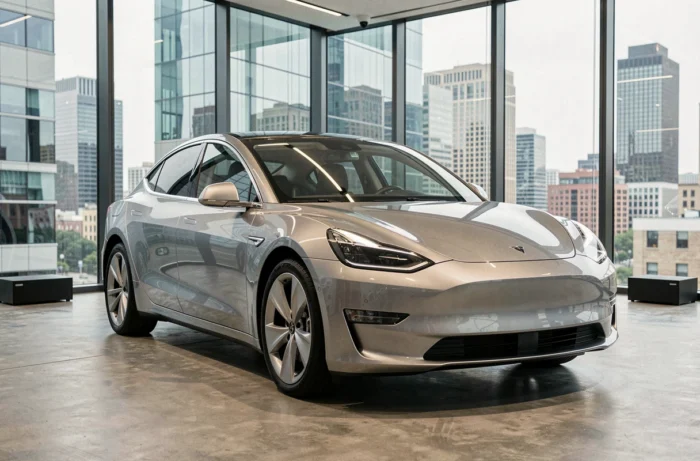
In 2024, the European automotive market grew by only 0.8% according to ACEA. Behind this near stagnation lies a profound upheaval: embedded technologies, powertrains, and even the way of buying a car have changed fundamentally. Understanding these changes allows for more informed choices, whether for a future purchase or simply to keep up with the evolution of the sector.
Non-rechargeable hybrids: the powertrain that truly dominates the European market
Advertisements highlight 100% electric cars, but the reality of the market tells a different story. In 2024, non-rechargeable hybrids accounted for 30.9% of new registrations in the European Union, according to ACEA data published in January 2025. Battery electric models reached 13.6%.
The conventional hybrid combines a thermal engine and a small electric motor that recovers energy during braking. No need for a charging station, no anxiety about range. The additional cost at purchase remains moderate compared to a pure thermal model. For a driver who mainly drives in the city with a few highway trips, this powertrain reduces consumption without imposing a change in habits.
Many manufacturers expanded their hybrid range in 2024, offering this technology on city cars, sedans, and SUVs. To find the latest references and compare models, visiting the Autonov website dedicated to cars allows you to browse different categories of vehicles.
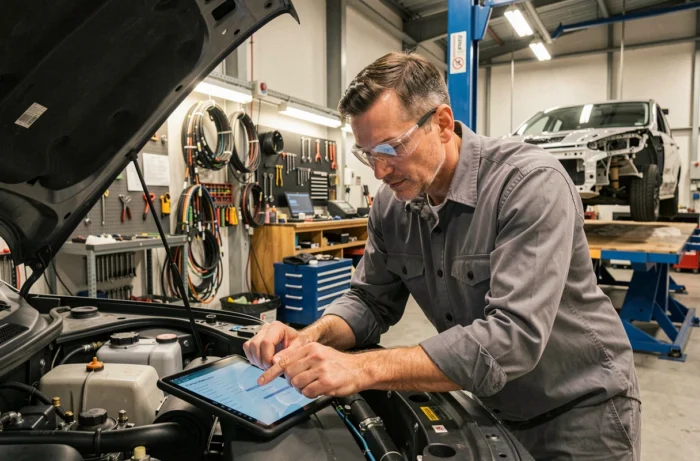
Social leasing in France: an electric car accessible to low-income households
One of the major barriers to purchasing an electric vehicle remains the price. In France, an experiment launched in 2024, called social leasing, aimed to overcome this obstacle. The principle: offer eligible households the rental of an electric car at a reduced rate, well below the typical market offers.
Demand exceeded expectations. Analyses reported by the Dutch press (NOS) and researchers from Sciences Po highlight that the volume of this scheme remains insufficient to transform the entire vehicle fleet. The number of vehicles available through this program covers only a fraction of the requests received.
This scheme illustrates an underlying trend: public authorities are seeking to accelerate the transition without leaving low-income earners behind. However, the gap between political ambitions and actual industrial capacity remains significant.
Artificial intelligence and driving: what is changing in vehicles
Artificial intelligence in the automotive sector is not limited to autonomous driving prototypes. In 2024, it has settled into more discreet but very concrete functions.
ADAS systems enhanced by AI
ADAS (Advanced Driver Assistance Systems) now use algorithms capable of learning from road situations. An emergency braking system that detects a partially obscured pedestrian, a lane-keeping assist that adapts to degraded markings: AI improves the reliability of existing sensors rather than adding new ones.
European AI regulation and its consequences
The gradual implementation of the European AI Act regulates the use of artificial intelligence according to its risk level. For manufacturers, this means that any AI system related to vehicle safety is classified as high risk and must meet strict requirements for transparency and reliability.
This regulation pushes manufacturers to precisely document how their algorithms function. A buyer will eventually be able to better understand how their vehicle makes certain decisions (braking, collision alerts, speed adaptation).
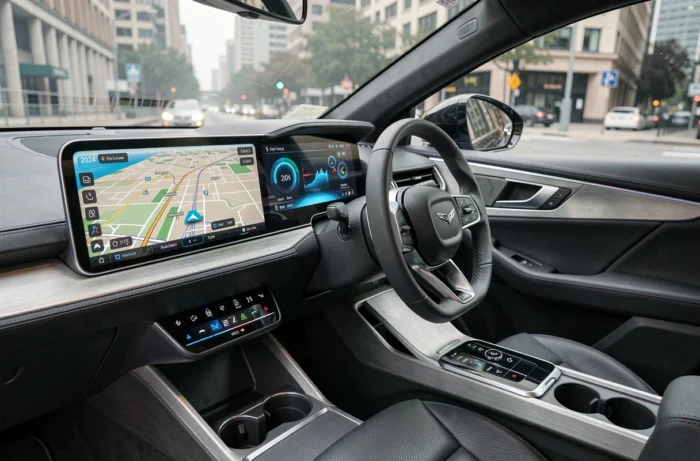
Batteries and range: where technology stands in 2024
Progress on lithium-ion batteries continues, but the expected technological breakthrough (solid-state batteries, in particular) has not yet reached mass production. Here’s what has actually evolved:
- The energy density of cells has improved, allowing new models to offer greater range without significantly increasing the weight of the battery pack.
- Fast charging times have decreased thanks to better electrical architectures (higher voltages, optimized cell cooling).
- The network of public charging stations continues to expand in Europe, gradually reducing the white zones that hinder adoption.
The real range in winter conditions remains the weak point of electric vehicles. Cold reduces the effective capacity of the battery and requires heating, two factors that can notably decrease the displayed range.
Automakers and new French models: clear strategic choices
French brands have focused their launches on two segments in 2024: affordable electric city cars and hybrid SUVs. This positioning reflects the actual demand in the European market, where small electric vehicles and family hybrid SUVs capture the majority of sales.
Chinese manufacturers, for their part, have intensified their presence in the European market with aggressively priced electric models. This competition has pushed several historic brands to revise their pricing structures or accelerate the launch of entry-level models.
The global market trend shows that automotive innovations in 2024 are not limited to a race for full electrification. Pragmatism prevails: drivers choose the powertrain that suits their daily use, and the industry adapts by diversifying its offerings rather than imposing a single technological trajectory.