
40 V battery brush cutters now achieve performance comparable to entry-level gas models while exhibiting significantly lower noise levels. This technological shift is a game changer for individuals living in subdivisions or condominiums, where coexistence imposes constraints that a product’s technical sheet does not mention. Choosing the right brush cutter in 2026 involves evaluating cutting power as much as anticipating neighborhood conflicts.
Noise thresholds in subdivisions: what municipal decrees really impose
There is no uniform national time frame for using a brush cutter. The permitted time slots are set by prefectural decrees and then refined by each municipality. The most common schedule allows use on weekdays from 8:30 AM to 12 PM and from 2 PM to 7:30 PM, with reduced hours on Saturdays and a short window from 10 AM to 12 PM on Sundays or public holidays.
Several municipalities go further and explicitly restrict the loudest gas engines by setting a threshold around 95 dB for gardening tools in urban areas. A traditional gas brush cutter often exceeds this threshold, making it potentially non-compliant in these areas. Online catalogs, such as the one available at debroussailleuse-warrior.com, generally specify the noise level of each model.
In condominiums, the internal regulations may add additional restrictions. Some property managers outright ban gas engines in common areas or adjacent private gardens. Before comparing engine sizes, it’s better to start by reading these regulations and consulting the decree of your municipality.

Gas or battery brush cutter: real comparison on a medium-sized garden
On a plot of a few hundred square meters with tall grass, scattered brambles, and borders to finish, the question of the type of motorization arises differently than on a hectare of wasteland.
Battery life and effective working time
A 40 V battery model offers sufficient autonomy to maintain a standard garden on a single charge. For larger plots or dense vegetation, two rotating batteries allow for uninterrupted work. The gas model, on the other hand, does not pose any autonomy questions but requires preparation time (mixing, priming) and regular maintenance of the carburetor and air filter.
Noise level in real conditions
This is the decisive criterion in subdivisions. A battery model generally operates well below the 95 dB threshold mentioned by the strictest municipal decrees. The entry-level gas model flirts with this limit, even exceeding it. The difference perceived by a neighbor ten meters away is significant: a two-stroke engine at full throttle on a Sunday morning remains the primary cause of noise complaints related to gardening.
Purchase budget
A budget of 80 to 150 euros allows for the acquisition of a reliable electric brush cutter (corded or battery) for regular use on a medium-sized garden. Equivalent gas models fall within the same range, but their operating costs (fuel, wear parts, engine maintenance) increase the bill over several seasons.
Cutting system and vegetation: adapting the tool to the terrain, not the other way around
The type of cutting head determines both efficiency and user comfort. Field feedback varies on this point depending on the exact nature of the vegetation, but a few concrete guidelines allow for an informed choice.
- Nylon line (round or square) is suitable for soft grasses, border finishing, and regular maintenance of a lawn that the mower cannot reach. It is the quietest and least aggressive configuration for fences and tree bases.
- The three-tooth blade or knife tackles brambles, young woody shoots, and thick grasses. It requires more engine power and generates more debris.
- The brush disc, reserved for the most powerful machines, is used for heavy clearing: shrub shoots, dense undergrowth, long-abandoned land. In subdivisions, this type of work remains exceptional.
For a regularly maintained garden, nylon line covers the vast majority of needs. Investing in an overpowered machine equipped with a clearing disc to mow borders is akin to using a chainsaw to trim a rosebush.
Ergonomics and harness: the factor that product sheets underestimate
On sloping or uneven terrain, the maneuverability of the machine is as important as its power. Two elements deserve special attention when choosing.
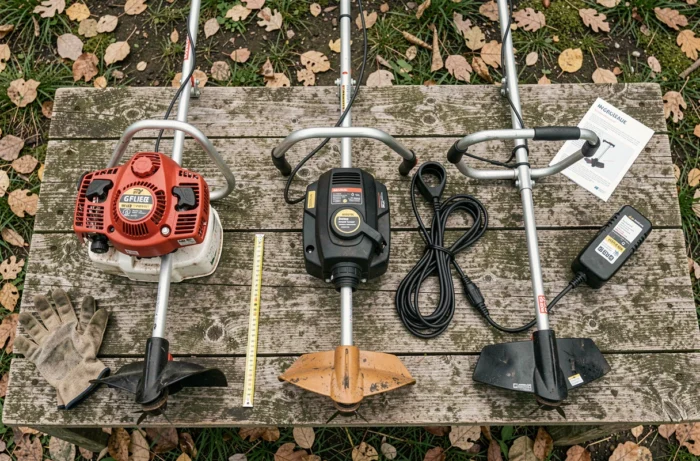
The type of handle radically changes the working posture. A loop handle offers more freedom of movement for cluttered areas (beds, hedge bases, slopes). A two-handed handle, similar to that of a bicycle, is better suited for large flat areas where the sweeping motion is regular.
The harness, often sold separately on entry-level models, distributes the weight across the shoulders and hips. Without a suitable harness, a brush cutting session of more than twenty minutes on sloped terrain causes back pain that discourages regular maintenance. A double strap harness with a detachable hook remains the best compromise between comfort and mobility.
Regular maintenance of a brush cutter: what determines its lifespan
The longevity of a brush cutter depends less on the brand than on the regularity of maintenance. On a battery model, operations are limited to cleaning the casing, replacing the line, and checking the battery (storage above freezing, partial recharging in winter).
On a gas model, the list expands:
- Oil change and air filter replacement at the beginning of the season
- Cleaning or changing the spark plug after each season of intensive use
- Checking the carburetor and priming system if starting becomes difficult
- Draining the tank before prolonged storage to avoid clogging
The ease of maintenance of battery models is a concrete advantage for occasional users who do not wish to invest time in mechanics. For those who already own other gas tools and master these tasks, the question arises differently.
The final choice rests on a trade-off between three parameters that do not appear on any technical sheet: the regulations of your municipality, the tolerance of your neighbors, and the time you are willing to devote to maintaining the machine itself. Consulting your municipality’s municipal decree before browsing catalogs allows you to directly target models that comply with local constraints.