
An online bottle may have a different INCI composition than one sold in-store, without the product being a counterfeit. Formulations vary according to batches, distribution areas, and local regulations. Therefore, buying a perfume online with confidence requires checking much more than just the name on the label.
INCI List and New Allergen Regulations: What the Product Sheet Reveals
Regulation (EU) 2023/1545 requires, starting from July 31, 2026, the individual listing of more than 80 fragrance allergens on the ingredient list, compared to about twenty previously. The declaration threshold is set at 0.001% for leave-on products like perfumes.
Further reading : Tips to Maximize Your Best Scores at the BCE and Avoid Bad Grades
For an online buyer, this development changes the game. Two perfumes from the same brand, purchased from two different sites, may display distinct INCI lists if one still carries the old labeling. Until July 31, 2028, both formats coexist in the market.
We recommend prioritizing product sheets that already publish the expanded list. This is a reliable indicator: the retailer works with recent batches and follows regulatory updates. Conversely, a sheet without any INCI mention or with a truncated list should raise alarms, especially on general marketplaces.
Recommended read : The best places for wild camping in the Landes with complete freedom
For those looking to buy a perfume on Masca Online, transparency about the composition is part of the selection criteria for the offered references.

Batch Code and Traceability of Online Perfume
The batch code (or lot number) engraved or printed on the bottle and packaging is the only element that allows tracing back to the manufacturing date and the original factory. Several free sites decode these codes by brand. A bottle without a batch code, or whose code does not match any known entry, is a strong signal of counterfeiting.
A consistent batch code between the bottle and packaging ensures a normal distribution channel. Counterfeiters often replicate the packaging but neglect this detail: the two codes do not match, or the bottle’s code refers to a manufacturing date inconsistent with the sale date.
Verification Points Before Cart Validation
- The batch code is listed on the product sheet or will be visible in photos of the actual lot (not a generic visual of the bottle).
- The seller explicitly mentions the origin of the stock: selective distribution, authorized clearance, or parallel import. Each channel has its implications for the warranty.
- The return policy covers cases where the scent does not match the expected reference, not just damaged bottles.
Specialized perfume platforms generally display this information. On general marketplaces, it is often necessary to ask the third-party seller before purchasing.
Comparing the Price of a Perfume Online: Beyond the Displayed Amount
The price per milliliter remains the only reliable comparison indicator. A discounted women’s or men’s gift set may seem advantageous, but the cost relative to the actual volume of the eau de toilette or eau de parfum sometimes reveals a hidden surcharge masked by the included accessories.
Seasonal promotions (end-of-series sales, private sales) often concern specific packaging. A 30 ml bottle on sale may be more expensive per milliliter than a 100 ml at the standard price. We regularly observe significant price discrepancies between the 50 ml version and the 100 ml version of the same fragrance, with the larger format almost always offering a better value for money.
Eau de Toilette, Eau de Parfum, Extrait: Concentration Changes the Calculation
Comparing the price of a men’s eau de toilette with that of an eau de parfum from the same brand makes no sense. The concentration of raw materials differs, as does the longevity on the skin. A high-priced perfume extract may end up being cheaper to use than an eau de toilette applied multiple times a day.
Specialized beauty and perfume sites systematically indicate the concentration. On marketplaces, this mention is sometimes absent or buried in the description. Checking the exact product designation (eau de toilette, eau de parfum, perfume, extract) avoids disappointment upon receipt.
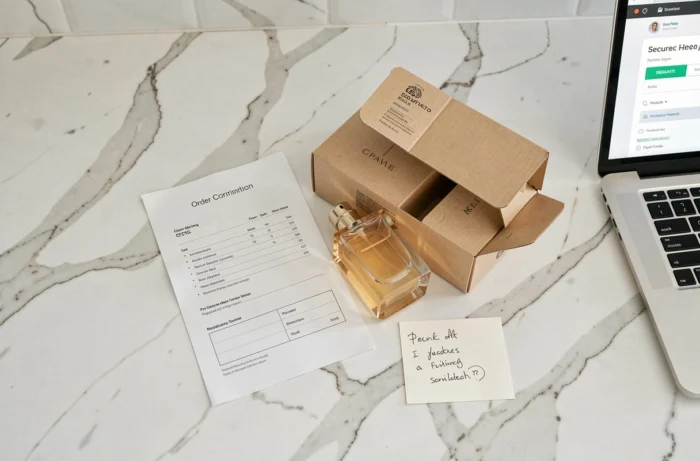
Recognizing a Reliable Perfume Reseller: Technical Criteria
Selective distribution, practiced by the majority of major perfume brands, theoretically limits sales to authorized resellers. A site offering dozens of premium brands at very low prices without mentioning its status as an authorized distributor or clearance seller deserves verification.
A reliable reseller publishes its general terms and conditions of sale with complete legal mentions, including the SIRET number or its European equivalent, the physical address, and customer service contact details. The absence of these elements is a dealbreaker, regardless of the displayed price.
- The presence of verified customer reviews (third-party platforms like Trustpilot or Avis Vérifiés) provides insight into dispute handling, not just overall satisfaction.
- The return conditions specify the timeframe, coverage of costs, and the cases covered (opened product, damaged packaging, reference error).
- The shipping method and packaging are detailed: a perfume shipped without thermal protection in the middle of summer risks altering the fragrance.
The online perfume market remains a sector where the quality of after-sales service distinguishes serious players from opportunistic resellers. A low price never compensates for an unusable product or an impossible return.