
The transformation of a house does not require a large annual renovation. It involves precise technical decisions: choice of coverings, management of indoor air quality, automation of recurring tasks. Here we discuss the concrete levers that sustainably modify comfort and the use of a home on a daily basis.
VOCs and indoor air quality: the overlooked parameter in decorative renovation
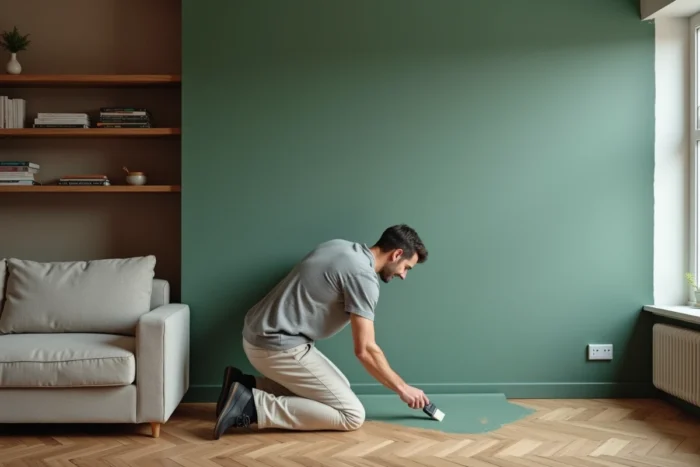
Repainting a wall or changing a floor covering remains the first instinct to refresh an interior. Most articles stop at the choice of colors. The real technical issue is the emission of volatile organic compounds after installation.
Further reading : Essential Tips and Resources to Support Parents Daily
ANSES has updated its recommendations on indoor air quality and household products. Paints, varnishes, and adhesives release VOCs for several weeks after application, sometimes several months for low-quality formulations. Choosing a paint labeled A+ is not enough: this classification measures emissions at 28 days, not the peak during the first days.
We recommend continuously ventilating the affected room for at least 72 hours after each intervention, with windows open or using an over-ventilated mechanical ventilation system. For kitchens and bathrooms, mineral coverings (tiles, polished concrete) emit significantly less than vinyl alternatives, even certified ones. An interior decoration choice that takes health into account alters the list of possible materials from the outset.
You may also like : Practical tips to help parents support their children daily
Additionally, it is useful to access the home page of Gazette Debout to cross-reference other feedback on materials and daily arrangements.
Home automation and task automation: what really changes daily life
Ademe documents a marked increase in households equipped with robot vacuums, connected lighting, and voice assistants dedicated to managing domestic tasks. This is no longer a gadget: partial automation of cleaning and thermal comfort frees up measurable real time during the week.
Three devices deserve to be prioritized:
- The robot vacuum with LiDAR mapping, programmed for fixed time slots. Recent models manage multiple surfaces (wood, tile, low-pile carpet) without manual intervention, provided the floor is cleared of small objects.
- Connected lighting scenarios, which allow for adjusting the color temperature according to the time of day. A warm light in the evening in the living area, a neutral white in the kitchen during meal preparation: the impact on visual comfort is immediate.
- Zone heating programming, combined with presence sensors. Reducing the temperature by two degrees in unoccupied rooms remains the simplest lever to lower consumption without affecting perceived comfort.
A common pitfall is to multiply incompatible ecosystems (Zigbee, Z-Wave, proprietary Wi-Fi). We observe that the Matter protocol simplifies interoperability between manufacturers, but not all devices support it yet. Checking compatibility before purchase prevents ending up with three separate apps to control a single floor.
Kitchen and bathroom renovation: balancing design and durability
The kitchen and bathroom concentrate the majority of transformation interventions. The choice of materials is more constrained here than elsewhere: humidity, grease splashes, thermal shocks.
A composite quartz countertop resists stains better than untreated granite, contrary to popular belief. Granite requires regular sealing, whereas composite quartz is non-porous by design. For intensive use in the kitchen, this is a determining selection criterion.
In the bathroom, large format porcelain stoneware (60×60 cm or more) reduces the number of joints, thus minimizing areas for mold accumulation. The glued installation on waterproof screed remains the most reliable technique for Italian showers. Extra-flat resin shower trays are an alternative, but their durability directly depends on the thickness of the gelcoat layer.
Colors and decor inspiration: what the field confirms
Kitchen decor trends are evolving towards earthy tones (terracotta, sage green, sandy beige) that better mask everyday dirt than glossy white. Practically, a matte finish hides fingerprints where a glossy finish reveals them under every angle of light.
For the bathroom, the return of bold colors on vanity units (midnight blue, forest green) creates a contrast with light wall tiles without sacrificing the room’s brightness.
Outdoor space layout: extending the interior to the garden
An underutilized garden or balcony represents lost space. Outdoor layout begins with defining distinct functional zones: dining, relaxation, vegetable garden, storage. Without this zoning, the space turns into a seasonal catch-all.
The choice of outdoor flooring affects future maintenance. Composite boards (wood-polymer) require neither sanding nor annual oiling, unlike natural wood. Their UV resistance varies according to the quality of the mix: co-extruded ranges retain their color significantly longer.
For small spaces, vertical landscaping (hanging planters, trellises for climbing plants) maximizes cultivable surface area without cluttering the ground. Aromatic herbs in wall planters, placed near the kitchen, combine decoration and daily use.
Transforming your home daily relies less on accumulating small tips than on technical choices made in advance. Low-emission materials, interoperable connected devices, coverings suited to the actual use of each room: these initial decisions determine comfort over several years.