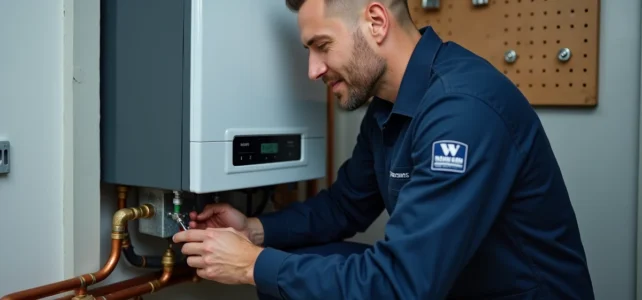
A gas boiler that has been in service for over fifteen years loses efficiency, consumes more, and is prone to costly breakdowns. Replacing your gas boiler involves making decisions between several technical options, preparing the existing hydraulic network, and navigating a framework of public aid that has changed significantly since 2024. This guide details the concrete decision points, from diagnosing the circuit to choosing the equipment.
Desludging and preparing the hydraulic network before replacement
Most replacement guides focus on choosing the new appliance. However, the network of radiators and pipes that will accommodate this boiler deserves equal attention.
Read also : What solutions to replace 3131 and report your missed calls?
After years of water circulation, deposits of sludge, metal oxides, and calcite accumulate in the pipes and heat exchangers. Installing new equipment on a contaminated circuit means throttling its efficiency from day one. The complete desludging of the network is now considered a technical prerequisite by serious heating professionals, in line with the DTU 60.1 standards.
The operation involves injecting a cleaning product, flushing the entire circuit, and then installing a magnetic sludge pot on the return circuit. This filter continuously captures metal particles and extends the life of the heat exchanger. The cost of desludging represents a fraction of the boiler’s price, but ignoring it can lead to measurable efficiency loss from the first heating season.
Recommended read : Practical tips and inspiration to transform your home daily
Before signing an installation quote, check that this service is explicitly included in the steps for changing a gas boiler proposed by the installer. A professional who does not mention desludging in their offer leaves a technical blind spot.
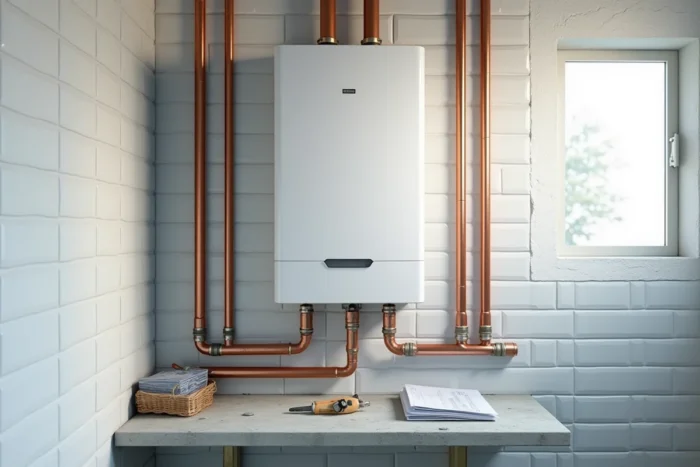
Gas condensing boiler, heat pump, or electric solution: three scenarios to compare
The classic reflex is to replace a gas boiler with a newer gas boiler. However, this reasoning should be compared with two other options before making a decision.
Gas condensing boiler
The gas condensing boiler recovers the latent heat from the flue gases to preheat the return water. Its efficiency significantly exceeds that of a conventional boiler. The installation remains simple when the home already has a gas connection and a compatible flue. The purchase and installation cost is generally lower than that of a heat pump.
Air-water heat pump
The air-water heat pump captures energy from the outside air to heat the existing hydraulic circuit. It consumes significantly less primary energy than a gas boiler, but its installation cost is higher. It works better with low-temperature emitters (underfloor heating, oversized radiators). In an old home equipped with small high-temperature radiators, additional heating may be necessary in extreme cold.
Electric radiators or electric boiler
Some well-insulated and modestly sized homes may opt for inertia electric radiators or an electric boiler. The initial investment is low, but the operating cost directly depends on electricity rates. This scenario only makes economic sense if the thermal insulation of the building is already effective.
- The gas condensing boiler is suitable when a gas connection exists, the budget is tight, and the home retains high-temperature emitters.
- The air-water heat pump becomes relevant if the home has low-temperature emitters or if a comprehensive renovation is planned, as public aid favors it.
- The all-electric solution is justified in a small, very well-insulated home where the required heating power remains limited.
Financial aid for replacing your gas boiler: what has changed since 2024
The landscape of aid has significantly evolved. Since 2024-2025, gas boilers, even very high-performance ones, are gradually excluded from MaPrimeRénov’ and the main CEE bonuses. A gas-to-gas replacement no longer receives the same financial support as it did a few years ago.
However, aid remains available for renewable energy equipment: heat pumps, biomass pellet boilers, and combined solar systems. The amount varies based on household income, geographical area, and the energy savings achieved after work.
This political direction changes the economic balance. Even if the gas condensing boiler is cheaper to purchase, the lack of subsidy reduces the gap with a subsidized heat pump. Therefore, before requesting a quote, it is useful to simulate the actual remaining costs for each scenario, incorporating available bonuses.

Boiler replacement quote: items to check before signing
A quote that boils down to a line “supply and installation of boiler” does not allow for serious comparison of offers. Several items must be listed separately.
- The price of the equipment (brand, model, power in kW) and the labor cost, separated.
- The desludging of the circuit and the installation of the sludge pot, with details of the process used.
- The possible compliance of the flue gas exhaust system, especially in the case of switching to condensing (flue lining or PVC connection).
- The removal and disposal of the old appliance, including the treatment of refrigerant fluid if the old installation contains it.
- The costs for commissioning, adjustment, and initial combustion check.
Requesting at least two detailed quotes remains the most reliable method to spot an overlooked item or an abnormally low charge that masks incomplete work. A certified RGE installer is required to unlock the financial aid related to energy renovation.
Replacing a gas boiler is not just about choosing an appliance. The condition of the hydraulic network, the type of existing emitters, and the current framework of public aid guide the decision as much as the catalog price. Having several scenarios priced by a qualified professional, demanding a complete quote item by item, remains the safest way to avoid unpleasant surprises upon project completion.