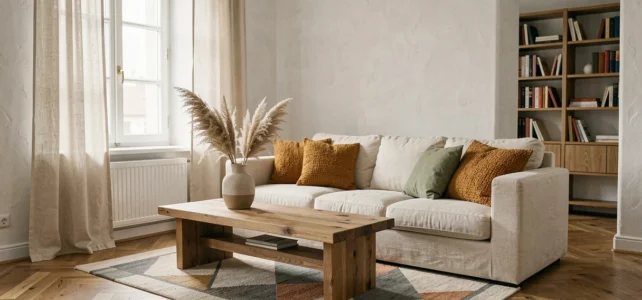
A sofa with rounded lines, a wall painted in a soft brown, a few plants arranged at eye level: modern decor is not just a catalog of styles. It reflects a way of living where every visual choice has a function, whether it’s to calm an overloaded room or to give character to a neutral living room. Understanding current trends allows for sustainable choices, not just aesthetic ones.
Curved shapes and organic lines in modern furniture
Have you noticed that right angles are becoming rarer in new furniture? This is no coincidence. Curved and organic shapes have become a strong marker of contemporary decoration. Specifically, this translates into sofas with rounded armrests, coffee tables with irregular contours, and oval or asymmetrical mirrors.
See also : Practical tips and inspiration to transform your home daily
This movement goes beyond just furniture. Interior architecture is also adopting these codes: painted arches on walls, rounded niches, shelves with soft silhouettes. The goal is to create a visual fluidity that softens living spaces.
Why this choice? Organic lines break the rigidity of a classic rectangular room. They naturally guide the eye from one point to another, making a living room or bedroom more welcoming. An enveloping armchair, for example, changes the perception of a reading nook without adding anything else. If you explore decor with Perspective Maison, you will find this logic of coherence between forms and uses.
You may also like : What solutions to replace 3131 and report your missed calls?
Color palette: from Mocha Mousse to deep shades
The choice of colors structures the ambiance of an interior much more than the furniture. In modern decoration, the trend leans towards warm and enveloping palettes, far from the clinical whites that have long dominated.
Mocha Mousse, Pantone 2025, serves as a benchmark for this evolution. This warm brown, between café au lait and soft terracotta, easily pairs with natural materials like wood, linen, or stone. It works well as a flat color on a wall or as accents (cushions, ceramics, frames).
Alongside this brown, deep shades are gaining ground. Bordeaux wine, dark sage green, and midnight blue add depth to a room without darkening it if used correctly. The practical rule: reserve intense colors for a single wall or specific elements, and keep neutral tones for the rest.
- Mocha Mousse pairs well with walnut, rattan, and off-white textiles for a cozy living room.
- Bordeaux wine works on an accent wall in a bedroom, paired with off-white and brass.
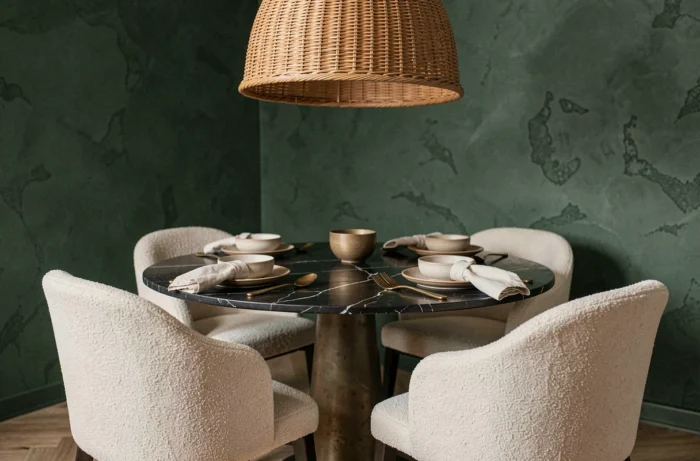
- Dark sage green adds a plant-like note to a dining room when combined with light wood.
Natural materials and texture mixing in the home
Modern decor places a central focus on materials. Wood remains a safe bet, but the way it is combined has changed. Dark woods like walnut are making a strong comeback, gradually replacing the bleached oak of previous years.
Mixing textures creates visual richness without overwhelming. A concrete example: a walnut table, chairs covered in linen, a jute rug, and a brushed metal light fixture. Four different materials in the same space, but connected by a coherent color palette.
Woven natural fibers (rattan, wicker, hemp) bring warmth to a room while maintaining a sober line. A woven basket placed next to a sofa, a rattan pendant light above a table: these elements are enough to give character to an interior without resorting to imposing pieces.
The trap of total natural look
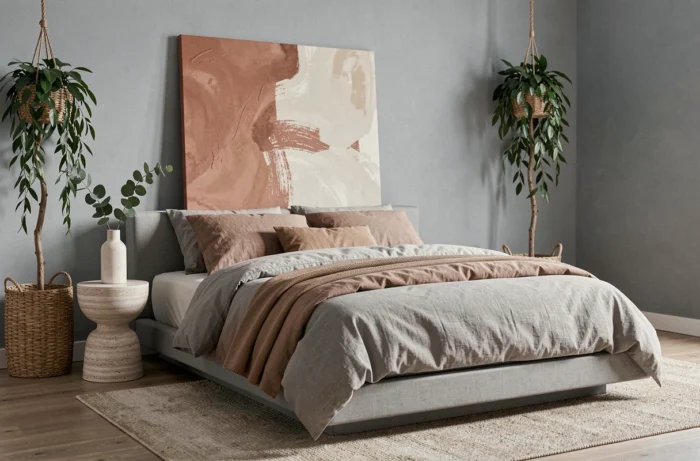
Betting everything on raw materials can produce the opposite effect of what is intended. A living room where everything is wood, linen, and beige ends up lacking contrast. Introducing a metallic element or a touch of bright color is enough to rebalance the whole. A glazed ceramic vase, a brass frame, or a cushion in a deep tone serve as a counterpoint.
Biophilic design: integrating greenery beyond houseplants
Placing a few plants on a shelf is something everyone does. Biophilic design goes further. This concept consists of reconnecting the interior to the natural environment by leveraging several simultaneous levers: natural light, living materials, views of the outside, and greenery integrated into the architecture.
Specifically, this can take the form of a living wall in an entryway, planters embedded in furniture, or simply a layout that maximizes light entry. The idea is not to turn your living room into a jungle, but to create regular points of contact with the living.
Spaces that incorporate this approach produce a measurable effect on perceived comfort. A room with a large window, raw materials, and a few well-placed plants feels more spacious and calmer than an identical space without these elements.
Discreet technology and modularity of spaces
An often-overlooked aspect of modern decor concerns the integration of technology. Ambient LED lighting, motorized curtains, invisible built-in outlets: tech visually disappears to better serve the purpose.
This discretion aligns with another strong trend, modularity. In urban spaces where square footage is limited, modular furniture (benches with storage, movable partitions, foldable desks) allows for transforming the same room according to the time of day.
- Indirect lighting on a dimmer changes the ambiance of a living room without altering the decor.
- A sliding partition between the kitchen and living area offers two configurations for the same space.
- A TV unit with a pivoting panel hides cables and adapts to multiple viewing angles.
Modularity is not reserved for small apartments. In a house, it allows for evolving a child’s room into an office or a living room into a reception area without having to buy everything new.
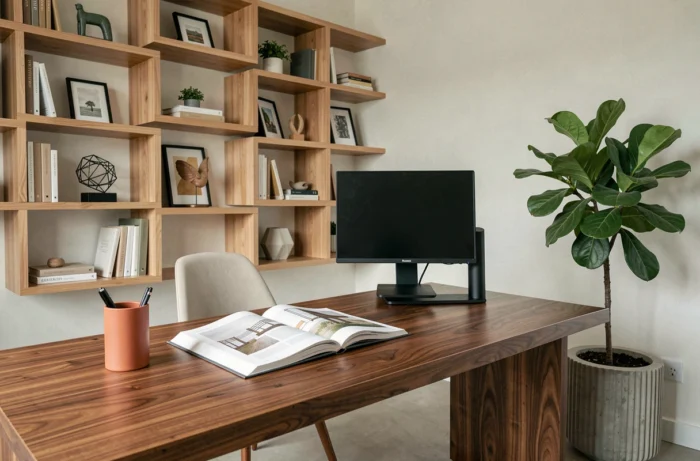
Modern decoration is built around a simple principle: each element serves a visual or practical function. A curved piece of furniture softens a volume. A deep color anchors a room. A raw material adds texture. When these choices are articulated around a coherent palette and real usage, the interior gains character without unnecessary effort.