
The French real estate market for the start of 2026 is sending mixed signals. Transaction volumes in the existing market are stabilizing, but new production continues to decline. Credit rates are rising, the rental stock is becoming scarcer, and a reform of the DPE planned for 2027 is already reshuffling the cards for landlord owners. What do the available data say about the actual direction of the market?
Mortgage Rates and Prices: Two Diverging Trends in September 2026
The start of the school year confirmed a trend that brokers had anticipated since spring. The majority of banks raised their rates by 10 to 20 basis points in September, in a context marked by the surge of the 10-year OAT and the return of inflationary pressures. This tightening changes the conditions for accessing credit for first-time buyers.
Prices, on the other hand, are not following the same trajectory. Several market observers report stagnation, or even a slight decline in certain metropolitan areas, while Paris maintains relative stability. The table below summarizes the trends observed in the main indicators.
| Indicator | Trend for Fall 2026 | Comparison to 2025 |
|---|---|---|
| Credit Rates (all durations) | Increase (+ 10 to 20 basis points) | Moderate decrease in 2025 |
| Transaction Volume (existing, 12-month rolling) | Stabilization | Gradual recovery in 2025 |
| Prices in the existing market | Stagnation or slight decline depending on the cities | Correction started mid-2024 |
| Rental Supply | Still very deficient | Structural shortage since 2020 |
| Unsold New Homes | High stock | Stock continuously increasing |
To follow these developments over the weeks, the news on Direct Home compiles key data from the sector and regulatory updates.

Rental Supply in France: A Worsening Shortage Despite Apparent Recovery
The most striking figure of this start of the school year concerns the rental stock. According to a market observer, the rental supply remains 55% below its 2019 level, despite a rebound recorded in the first half of 2026. This deficit is not evenly distributed: small units, targeted by students and young professionals, are the most affected.
Three factors combine to explain this situation:
- The withdrawal of rental investors from the purchase market. Their share of sales has been decreasing for several quarters, which mechanically reduces the number of properties available for rent.
- The persistent weakness of new production. With a stock of unsold new homes that remains high and reservations stagnating, the gap between production and absorption of the stock is becoming entrenched.
- The regulatory tightening on energy-inefficient properties, which pushes some landlords to withdraw their properties from the rental market rather than undertake renovation work.
This structural tension fuels the rise in rents in major cities. Paris, Lyon, Bordeaux, and Montpellier are among the metropolitan areas where rental pressure remains the highest. The phenomenon also affects medium-sized cities, which see their post-COVID attractiveness clash with an insufficient stock.
Rental Investment: A Vicious Cycle
Fewer investors mean fewer homes available for rent. Fewer available homes drive rents up, which increases political pressure to further regulate rents. This regulation, in turn, reduces the perceived profitability of rental investment. Several analyses from 2026 describe this mechanism as a lasting brake on the reconstruction of supply.
DPE Reform 2027: What Changes with the Decree of August 13, 2026
The energy performance diagnosis remains a central topic for the market. A decree published in the Official Journal on August 13, 2026, provides for a new presentation of the DPE starting January 1, 2027. This text introduces several concrete modifications in the content of the diagnosis.
The new DPE will include more information about renewable energies used in the housing, the main energy vector, and the property’s ability to respond to signals from the electrical grid. This last concept, still little known to the general public, concerns consumption flexibility: a home equipped with a programmable hot water tank or a controllable heat pump will be better valued.
Impact on Energy-Inefficient Properties
The recalculation of the DPE favors electric heating over gas, which changes the energy label of many apartments without any work being done. For landlord owners, the automatic reclassification to F or E due to the new calculation allows some properties to return to the rental market, which could partially alleviate the supply shortage.
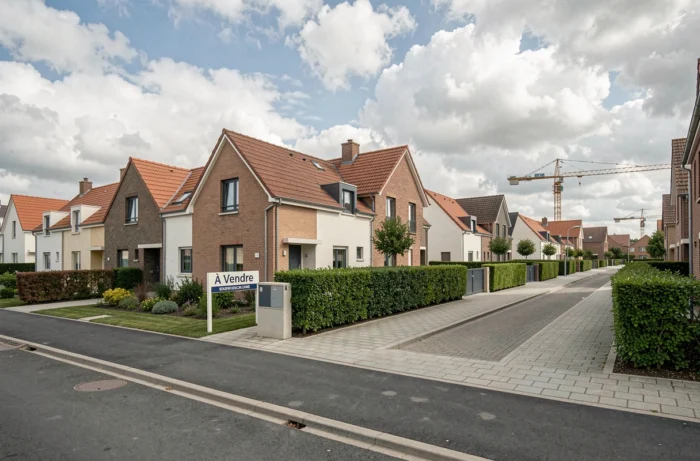
New Real Estate Market: Unsold Stock as a Leading Indicator
The gap between supply and demand in the new market deserves careful reading. Listings are increasing, but reservations are declining or stagnating. This phenomenon creates a high stock of unsold properties at the national level.
This stock is not only a problem for developers. It signals a deeper blockage: the prices of new properties, inflated by construction costs and environmental standards, remain too high for a significant portion of buyers, especially as rising rates reduce their borrowing capacity.
The weakness of new production also fuels the rental crisis. Fewer delivered programs mean fewer homes available in the future, in a context where rental demand does not weaken. Several sources from 2026 present this construction insufficiency as one of the structural factors of tension in the housing market.
The start of the school year in 2026 outlines a French real estate market caught between opposing forces: a rental demand that does not decline, a supply that struggles to rebuild, rising credit rates, and a regulatory framework that continues to evolve. The most revealing data remains that of the rental supply, still more than half of its volume compared to 2019.
It is on this imbalance that the trajectory of rents and housing accessibility will play out in the coming months.