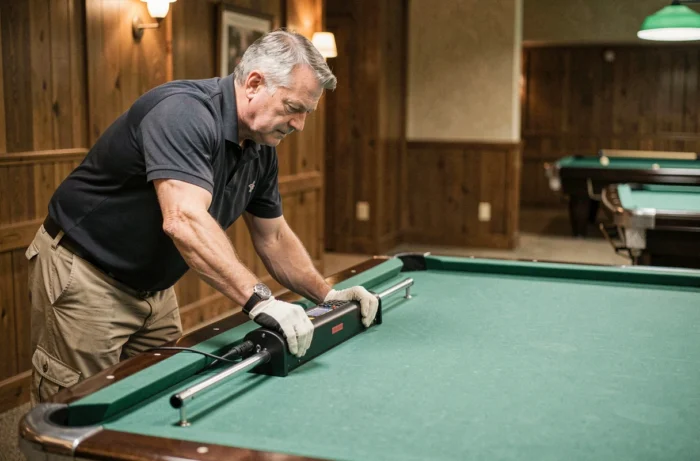
On a a carom billiard, a ball can travel more than ten meters before reaching its target. At this distance, the slightest friction of the cloth changes everything: deviated trajectory, dampened effect, missed repositioning. It is precisely to reduce this rolling resistance that billiard heating exists, and the question of its implementation remains central in French clubs.
Rolling resistance of the cloth: what heating changes concretely
The carom billiard cloth is chosen to be thin to limit friction, but this fineness makes it sensitive to ambient humidity. When the surface temperature drops, the fibers of the fabric absorb more moisture, swell slightly, and irregularly slow down the ball. What players call a “heavy” billiard is then observed: long shots become unpredictable.
A moderate heating of the surface, a few degrees above the ambient temperature, is enough to dry the fibers of the cloth. The fabric regains its flexibility, rebounds on the cushions become more consistent, and side effects transmit better. For disciplines with multiple cushions (three cushions, artistic), the difference is clear from the first series.
A point often comes up in club discussions: the belief that a heated ball “rolls better” by itself. In reality, it is mainly the condition of the cloth that determines the quality of the roll. You can learn more about heated billiards to understand the physics behind this phenomenon, but the main mechanism remains the management of the fabric’s hygrometry.
Removal of the federal obligation: what it changes for billiard clubs
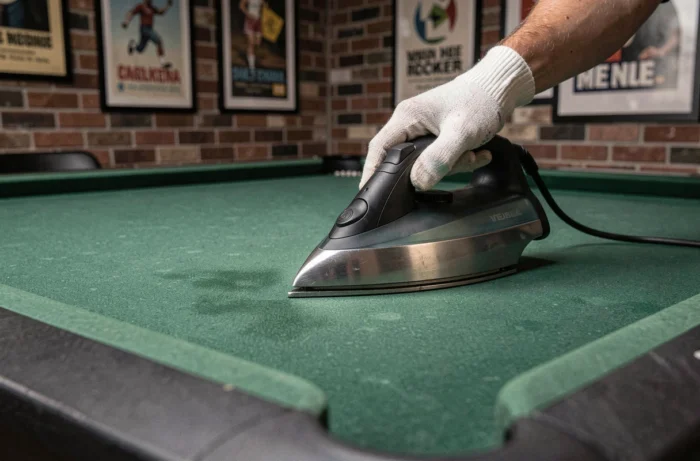
Article 1.1.07 of the Sports Code of the French Billiard Federation imposed a playing surface temperature between 25 and 30 °C. This obligation has been removed. The heating of the playing surface is no longer regulated by the federation.
This removal does not mean that heating has become unnecessary. It rather opens up maneuvering room: a club can decide to heat only during competitions, to modulate according to attendance times, or to completely turn off the heating on certain practice tables.
Energy sobriety and legal constraints
French texts on energy sobriety set temperature ceilings in sports facilities open to the public. Depending on the type of activity, the limit is between 14 and 18 °C for halls, and 20 °C for annexes (changing rooms, showers). Therefore, a club cannot raise the ambient temperature to 22 or 23 °C hoping to “help” the heating of the billiard without risking non-compliance.
This framework encourages to dissociate the heating of the room and that of the table. Heating the slate locally is much more economical than overheating the entire room. Clubs that pay their electricity bills have understood this for a long time.
Installation of billiard heating: methods and technical choices
The principle is simple: a heating element is placed under the slate, insulated from below to direct the heat towards the playing surface. In practice, several configurations coexist.
- The resistive heating wire laid out under the slate, with an insulating layer below. This is the historical system, present in the majority of clubs. The wire is an insulated resistive conductor, covered with a mass braid connected to the ground. Simple and inexpensive, but the insulation (often fiberglass) ages poorly and eventually comes apart after a few decades.
- The thermostatic heating panel, fixed under the top. This system integrates a thermostat that maintains the surface within a stable range. More consistent than loose wire, it avoids localized hot spots that can deform the cloth over time.
- The insulating covers placed on the billiard when it is not in use. They do not heat, but retain residual heat and reduce consumption. A billiard player interviewed by the French Billiard Federation indicated a reduction of about 30% in consumption thanks to these covers.
Replacement of aging heating
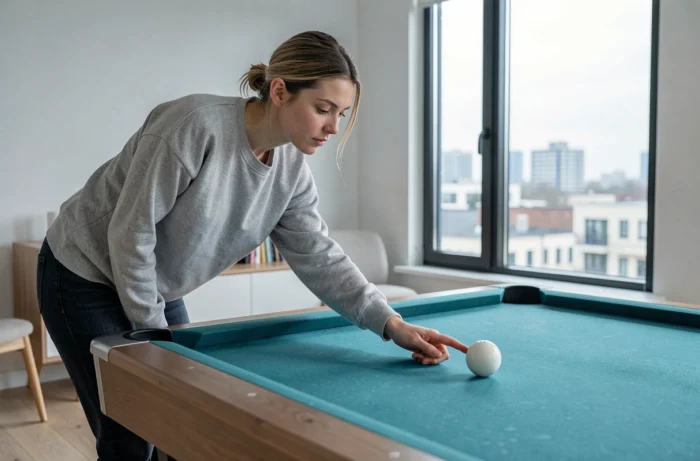
When opening a club billiard for the first time, one often finds a heating wire laid loosely on degraded insulation. The replacement involves completely removing the old system, installing new insulation (rigid foam or reflective panel), and then installing a new wire or panel.
The thermostat is the part not to be neglected. Without regulation, the surface can get too hot and dry out the cloth to the point of premature wear. An adjustable thermostat allows aiming for a few degrees above the ambient temperature, no more. Feedback varies on this point, but most billiard players agree on a difference of five to ten degrees compared to the room temperature.
Heated or non-heated billiard: should you always heat in French billiards
With the arrival of cloths like Royal Pro (Iwan Simonis), some clubs have chosen to completely eliminate heating. This cloth, designed to provide fast rolling without thermal assistance, changes the game for three-cushion players.
The transition to non-heated does not happen without resistance. Psychologically, many players associate quality billiards with a heated surface. Several billiard players note that performances remain comparable, but that crossing the threshold is primarily a mental challenge.
For a home billiard, the question arises differently. The room is generally heated continuously, and the hygrometry is better controlled than in a club room. A heating system under the slate remains useful if the billiard is located in a cool room (converted garage, basement), but becomes unnecessary in a living room maintained around 19 or 20 °C.
The choice therefore depends on three factors: the discipline practiced (multiple cushion carom benefits more from heating than American billiards or snooker), the quality of the installed cloth, and the thermal conditions of the room. A good cloth in a stable room makes heating optional, while a cold room with standard cloth makes it almost necessary for regular play.