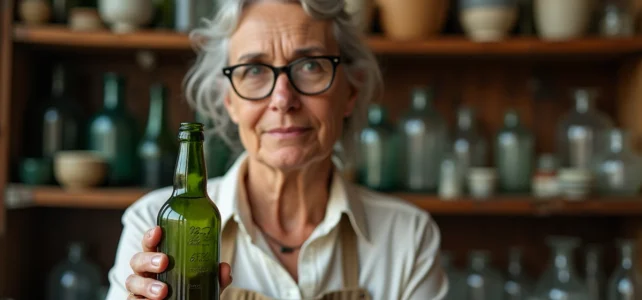
You come across a glass bottle in an attic, at the back of a garden, or at a flea market, and the first question always arises: when is it from? Before seeking an expert, some visible clues to the naked eye can already help place an old bottle within a time frame. The color of the glass, the side seams, the shape of the base, or the molded markings each tell a piece of the manufacturing history.
Molded markings and codes on the bottom of the glass bottle
The first instinct when turning over a bottle is to look at its bottom. Sometimes you will find a mold number, a glassworks symbol, or a production code. These elements are the most reliable for dating an old glass bottle because they are linked to well-documented production techniques.
See also : How to Check if a Business is Permanently Closed: Methods and Practical Tips
On mouth-blown bottles (before mechanization), the bottom often bears a pontil mark, a rough scar, or a ring left by the metal rod that held the bottle during blowing. A raw pontil mark generally indicates a manufacture prior to 1870. After this period, pontils were gradually replaced by techniques that held the bottle by the bottom of the mold, leaving a smooth base or one marked with concentric circles.
For more recent bottles, you can find information on Jardindivert that details the different types of markings according to the eras. Glassworks began to apply identifiable logos during the 19th century, and these marks are listed in specialized databases.
You may also like : Essential Tips and Resources to Support Parents Daily
A simple rule to remember: a bottle without any recycling symbol or factory code is likely to be from before the 1970s-1980s. Traceability requirements for food packaging tightened in Europe starting in the 2000s, with mentions of volume, lot codes, and recycling logos directly molded into the glass.
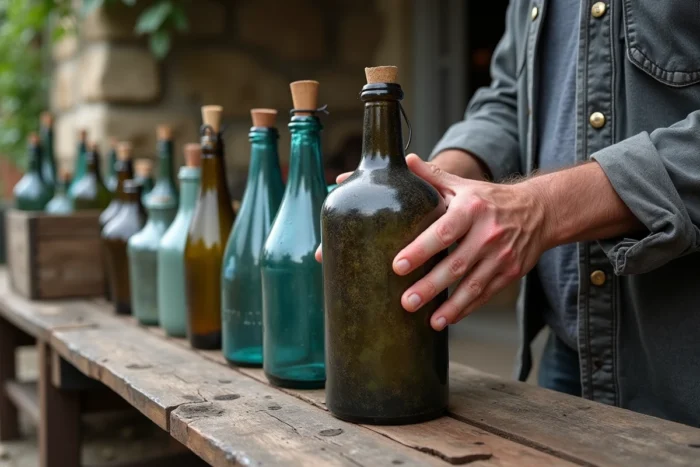
Side seams of glass and molding technique
The vertical lines running along a bottle are not a defect. They are the seams left by the joining of the mold parts, and their position on the bottle provides a direct indication of the manufacturing period.
- Seam that stops below the shoulder or at mid-body: the bottle was partially hand-blown in a partial mold. This is often before 1880.
- Seam that rises to the neck but stops before the lip: produced by semi-automatic molding, typical of the 1880-1910 period.
- Seam that crosses the lip to the top of the neck: fully mechanized production, which places the bottle after about 1910-1920.
This criterion works well in conjunction with the bottom. A bottle with a raw pontil will never have a seam crossing the lip, and vice versa. The two clues must be consistent with each other.
Beware of reproductions
Some decorative bottles made recently imitate old shapes but feature sharp and regular seams, typical of modern industrial molding. If the seam is perfectly smooth and symmetrical on a bottle that appears old, it is likely a reproduction. The seams of genuine old molds often show slight irregularities.
Color of old glass: what the hue reveals
The color of a glass bottle depends on its chemical composition, and the materials used have evolved over time. It is not as precise a dating criterion as seams or markings, but it can help eliminate certain periods.
Aqua glass, between pale green and blue-green, is characteristic of bottles made before 1920. This hue comes from natural iron impurities in the sand used. When glassmakers wanted to produce clear glass, they added manganese as a decolorizing agent. This manganese glass has a particularity known to collectors: when exposed to sunlight for a long time, it takes on a purple or amethyst hue. A purple glass bottle often indicates production between 1880 and 1920.
Amber glass (brown) was used over a very long period to protect the contents from light, especially for beer and certain pharmaceutical products. The hue alone is therefore not sufficient to date these bottles precisely. It must be cross-referenced with other clues.

Labels, neck, and overall profile of the bottle
When the bottle still bears a label, even a partial one, it is a valuable source of information. Printing techniques, typographic style, and legal mentions help to date the object. A multi-colored lithographed label with Art Nouveau characters points to the late 19th or early 20th century.
The profile of the neck also provides clues. Hand-applied lips (a glass ring added to the still-hot neck) precede mechanically molded lips. An irregular lip, slightly asymmetrical, with tool marks, indicates artisanal production.
- Neck with applied lip showing irregularities: before 1900-1910.
- Neck with threading for screw cap: after 1920-1930 in most cases.
- Standardized neck with crown ring (cap): widespread during the 20th century.
The weight of the bottle also comes into play. Hand-blown bottles often have irregular glass thicknesses, with some areas thinner and others thicker, sometimes with air bubbles trapped in the wall. A bottle that is perfectly uniform in thickness is a sign of mechanized production.
For beginners, the most reliable method remains to cross-reference at least three criteria (bottom, seams, color, or neck) before making a judgment on a dating range. A single clue can be misleading, especially for objects that have circulated or been reused for decades. Dating an old glass bottle is not an exact science, but with these concrete markers, one can avoid the most common mistakes.